TABLE OF CONTENTS
- Why Office Relocations Are Different From Residential Moves
- The Hidden Cost of Business Downtime
- Start Planning Earlier Than You Think
- Building Your Internal Relocation Team
- Creating a Realistic Office Moving Timeline
- Protecting Technology and Critical Business Data
- Preparing Employees for Moving Day
- Why After-Hours Office Moves Reduce Downtime
- Common Office Moving Mistakes
- Office Relocation Planning Checklist
- Frequently Asked Questions
- Final Thoughts
How to Move an Office Without Interrupting Your Business Operations
An office relocation in Northern Virginia is one of the most significant operational projects a business can undertake. Unlike a residential move, a commercial office relocation affects employees, technology, customer service, productivity, and revenue.
Every hour your business is unable to operate can have financial consequences. Missed client calls, delayed projects, interrupted workflows, and disconnected technology all contribute to unnecessary downtime that many companies underestimate until moving day arrives.
Fortunately, office relocations don’t have to disrupt your business. With careful planning, clear communication, and an experienced commercial moving company, businesses can relocate efficiently while maintaining productivity throughout the transition.
Whether your company is moving from Fairfax to Tysons, relocating an office in McLean, expanding into a larger facility in Ashburn, or opening a new location in Reston, understanding how to prepare before moving day is the key to a successful commercial relocation.
Why an Office Relocation in Northern Virginia Requires Specialized Planning
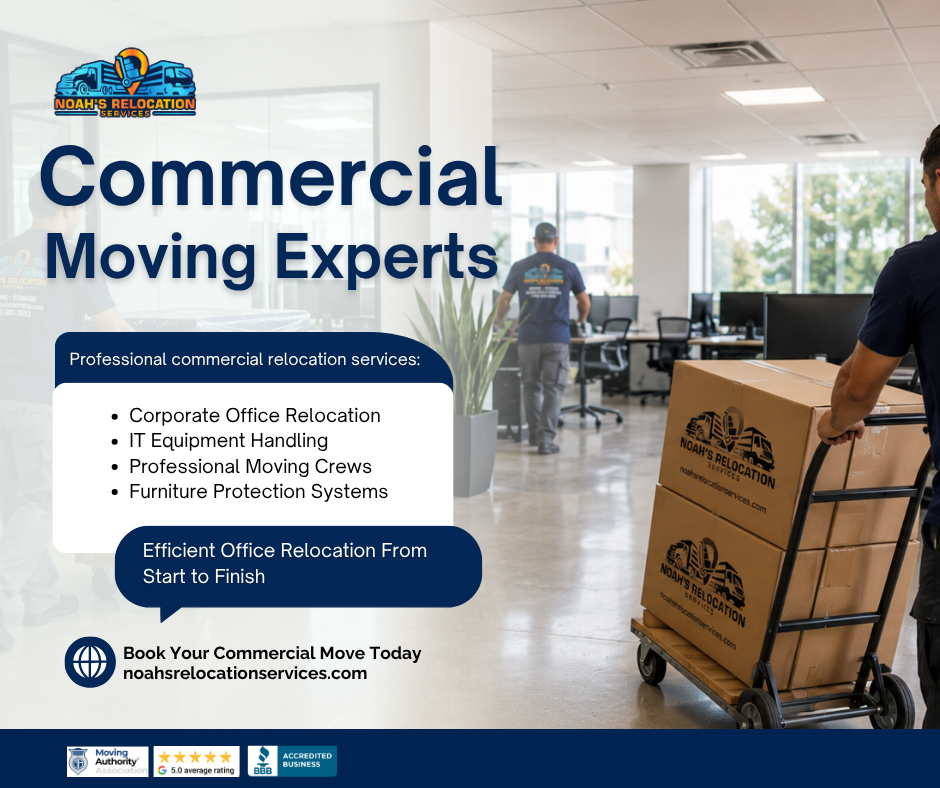
Many business owners assume moving an office follows the same process as moving a home. While both involve transporting furniture and belongings, the similarities end there.
An office relocation requires coordinating multiple departments, protecting valuable equipment, maintaining communication with employees, minimizing customer disruptions, and ensuring the new workplace becomes operational as quickly as possible.
Commercial moves often include:
- Hundreds of workstations
- Computer systems
- Servers and networking equipment
- Conference rooms
- Filing systems
- Office furniture
- Sensitive business documents
- Specialized equipment
Unlike residential moves, every decision made during a commercial relocation directly impacts the company’s ability to continue operating.
The objective is not simply to move furniture—it’s to move an entire business with as little disruption as possible.
The Hidden Cost of Business Downtime
When companies evaluate commercial moving quotes, they often focus exclusively on the price of the move itself. However, the moving service is usually only a fraction of the total cost associated with relocating a business.
The largest expense is frequently lost productivity.
Every hour employees cannot access their computers, answer customer inquiries, process orders, or complete projects represents a financial cost that can quickly exceed the moving budget.
Downtime may affect:
- Employee productivity
- Customer satisfaction
- Revenue generation
- Internal communication
- Sales opportunities
- Project deadlines
- Vendor relationships
For many organizations, reducing downtime by even a single business day can provide savings that far outweigh the investment in hiring experienced commercial movers.
Before finalizing your relocation budget, it’s important to understand all the factors that influence commercial moving expenses. Our How Much Does It Cost to Move in Northern Virginia? guide explains what impacts pricing and how to prepare an accurate moving budget for your business.
This is why successful office relocations focus first on operational continuity—not transportation.
Expert Insight from Noah’s Relocation Services
One of the biggest differences we notice between successful office relocations and stressful ones is planning.
Businesses that begin organizing their move at least six to eight weeks in advance almost always experience smoother transitions than those trying to coordinate everything during the final two weeks.
Early planning gives every department enough time to prepare, communicate, and organize without creating unnecessary pressure on employees.
Start Planning Earlier Than You Think
The most successful office relocations rarely happen because of luck.
They happen because someone started planning early.
Ideally, planning should begin six to twelve weeks before moving day, depending on the size of the organization.
This early planning period allows businesses to:
- Select the right commercial moving company
- Coordinate with property management
- Reserve elevators and loading docks
- Schedule internet and phone installation
- Notify utility providers
- Update vendors and service providers
- Prepare employees
- Develop a realistic moving timeline
Starting early also creates flexibility if unexpected changes arise during the relocation process.
The more organized the planning phase becomes, the smoother moving day will be.
Build an Internal Office Relocation Team
One of the most common mistakes businesses make is assigning the entire office relocation to a single employee.
Office moves affect every department differently.
Instead, establish a relocation team with representatives from key areas of the company.
Typical departments include:
- Executive Management
- Human Resources
- Information Technology
- Operations
- Facilities Management
- Finance
- Department Managers
Each representative becomes responsible for communicating updates, organizing department-specific tasks, and helping employees prepare for the transition.
This collaborative approach significantly reduces confusion and improves accountability throughout the relocation process.
Create a Realistic Office Moving Timeline
Every successful commercial relocation follows a structured timeline.
Rather than treating moving day as a single event, divide the project into manageable phases.
8–12 Weeks Before Moving
- Hire your commercial moving company.
- Confirm your moving date.
- Review the layout of the new office.
- Assign relocation responsibilities.
- Begin creating a detailed inventory.
6 Weeks Before Moving
- Schedule internet installation.
- Notify utility providers.
- Begin ordering moving supplies.
- Identify furniture that will be replaced.
- Develop workstation labeling procedures.
4 Weeks Before Moving
- Begin packing non-essential items.
- Label furniture by department.
- Confirm access requirements for both buildings.
- Notify customers of the upcoming relocation if necessary.
2 Weeks Before Moving
- Back up all company data.
- Finalize employee moving instructions.
- Confirm the moving schedule with your office moving company.
- Review building access procedures.
A structured timeline transforms what could be a chaotic project into a manageable operational plan.
If your company is relocating to another state, planning becomes even more important. Read our Interstate Movers in Northern Virginia guide to understand the additional logistics, regulations, and timelines involved in long-distance business relocations.
Pro Tip
Schedule your office move for a Friday evening or over the weekend whenever possible.
This allows employees additional time to settle into their new workspaces before business resumes on Monday, minimizing disruption and reducing pressure on your IT team during business hours.
Protect Your Technology Before Moving Day
For most businesses, technology is the backbone of daily operations. Computers, servers, printers, networking equipment, and communication systems must be handled with exceptional care during an office relocation.
Before moving day, work closely with your IT department or managed service provider to create a technology transition plan.
This plan should include:
- Backing up all critical business data
- Photographing cable connections before disconnecting equipment
- Labeling every monitor, computer, keyboard, and accessory
- Identifying equipment that requires special handling
- Scheduling internet and phone installation before employees arrive
Proper preparation allows your IT team to reconnect systems quickly, reducing downtime and helping employees return to work without unnecessary delays.
Employee Communication Is Just as Important as Logistics
An office move affects every employee differently. While leadership may focus on logistics, employees are often thinking about parking, new workspaces, commuting changes, and how the relocation will impact their daily routine.
Clear communication helps reduce uncertainty and keeps everyone engaged throughout the process.
Consider providing regular updates that include:
- Moving timeline
- New office address
- Parking instructions
- Building access procedures
- New workspace assignments
- Expectations for moving day
Employees who know what to expect are far more likely to support the relocation and adapt quickly after the move.
Why Weekend and After-Hours Office Moves Are Often the Best Choice
One of the most effective ways to reduce operational disruption is scheduling the relocation outside normal business hours.
Many businesses choose:
- Friday evening
- Saturday
- Sunday
- Holiday weekends
Moving after hours allows employees to finish the workweek normally while giving the moving crew uninterrupted access to the office.
By Monday morning, furniture can be placed, workstations assembled, and employees can begin working almost immediately.
For many organizations, after-hours office moving is one of the best investments they can make because it protects productivity without extending the overall project timeline.
Expert Insight from Noah’s Relocation Services
One strategy that has consistently helped our commercial clients reduce downtime is color-coded workstation labeling.
Instead of labeling furniture with employee names alone, assign each department a different color and use matching labels on desks, chairs, computers, monitors, and boxes.
This allows movers to place every workstation in the correct location immediately upon arrival, making setup faster and significantly reducing confusion during unpacking.
Develop a Packing Strategy Before Moving Day
Packing is often underestimated during office relocations.
Unlike residential moves, offices contain sensitive documents, expensive electronics, confidential information, and specialized equipment that require organization as much as protection.
A professional commercial packing strategy should include:
Department-by-Department Packing
Pack one department at a time to avoid mixing equipment between teams.
Clearly Labeled Boxes
Every box should identify:
- Department
- Employee
- Contents
- Destination room
Separate Essential Equipment
Items required immediately after the move should be packed separately for easy access.
Examples include:
- Internet equipment
- Routers
- Employee laptops
- Phone systems
- Daily office supplies
This simple strategy can save hours during setup. If your business prefers to leave packing, furniture protection, and workstation preparation to professionals, learn what’s included in our Full-Service Movers in Northern Virginia guide and discover how comprehensive moving services can simplify your office relocation.
Coordinate With Building Management
Every commercial building has different requirements.
Before moving day, confirm:
- Elevator reservations
- Loading dock availability
- Parking permits
- Building access hours
- Insurance requirements
- Certificate of Insurance (COI) requests
Failing to coordinate these details can delay an otherwise well-planned move.
Common Office Moving Mistakes Businesses Should Avoid
Even well-managed companies sometimes overlook small details that create major problems on moving day.
Avoid these common mistakes:
Waiting Too Long to Plan
Last-minute planning reduces scheduling flexibility and increases stress.
Forgetting to Label Equipment
Unlabeled computers, monitors, and furniture slow down installation and create confusion.
Underestimating IT Requirements
Technology often takes longer to reconnect than expected.
Schedule adequate time for testing before employees return.
Choosing Movers Without Commercial Experience
Office relocations require different skills than residential moves.
Choose a commercial moving company with experience handling offices, technology, and business logistics.
Before hiring any commercial mover, verify that the company is properly licensed and insured. Our guide on Licensed vs Unlicensed Movers in Northern Virginia explains why credentials matter and how to protect your business from unnecessary risk.
Ignoring Employee Communication
Employees should never discover important moving information at the last minute.
Frequent communication improves cooperation and reduces anxiety.
Commercial Office Relocation Checklist
Use this checklist to help prepare for your office move.
Before the Move
✔ Hire an experienced commercial moving company
✔ Assign an internal relocation coordinator
✔ Create a detailed moving timeline
✔ Inventory office furniture and equipment
✔ Schedule internet and utility installation
✔ Notify vendors and service providers
✔ Reserve elevators and loading docks
✔ Back up all company data
During the Move
✔ Supervise department labeling
✔ Protect confidential documents
✔ Verify inventory before loading
✔ Maintain communication with movers
✔ Confirm workstation placement
After the Move
✔ Test internet and phone systems
✔ Verify all computers are operational
✔ Walk through the office
✔ Report any issues immediately
✔ Welcome employees into the new workspace
Frequently Asked Questions
How far in advance should I plan an office relocation?
Most businesses should begin planning six to twelve weeks before moving day. Larger offices or companies with complex technology infrastructure may require even more preparation.
How can we reduce employee downtime during an office move?
Planning ahead, communicating clearly with employees, labeling workstations, and scheduling the move during evenings or weekends are some of the most effective ways to minimize operational disruption.
Should our IT department disconnect all computers before movers arrive?
Yes. Your IT team should back up important data, disconnect equipment properly, and document cable configurations before moving day to simplify reinstallation.
Can professional movers pack office equipment?
Absolutely. Experienced commercial movers can professionally pack computers, monitors, office furniture, conference room equipment, filing systems, and other business assets using specialized packing materials and proven handling techniques.
Why should I hire commercial movers instead of residential movers?
Commercial relocations involve business continuity, technology, confidential documents, employee coordination, and strict timelines. Professional commercial movers understand these challenges and are trained to execute office relocations efficiently while minimizing disruption.
Final Thoughts
An office relocation is much more than moving furniture from one building to another. It’s a business project that requires planning, communication, organization, and experienced execution.
Companies that invest time in preparing their employees, coordinating technology, and partnering with professional commercial movers are far more likely to experience a smooth transition with minimal disruption to daily operations.
A successful office move isn’t measured by how quickly the truck is unloaded—it’s measured by how quickly your employees can get back to serving your customers.
Looking for a complete overview of commercial moving solutions? Explore our Professional Office Moving Services in Northern Virginia page to learn how our experienced team manages office relocations of every size with minimal disruption to daily operations.
Ready to Plan Your Office Relocation?
Whether your business is relocating within Fairfax, McLean, Tysons, Ashburn, Reston, Vienna, or anywhere in Northern Virginia, our experienced commercial moving specialists are here to help you minimize downtime and keep your business moving forward.
From detailed planning and professional packing to after-hours office relocations and complete workstation setup, we provide customized commercial moving solutions designed around your operational needs.
Contact Noah’s Relocation Services today to schedule a free commercial moving consultation and discover how a professionally managed office relocation can protect your business, your employees, and your productivity.